



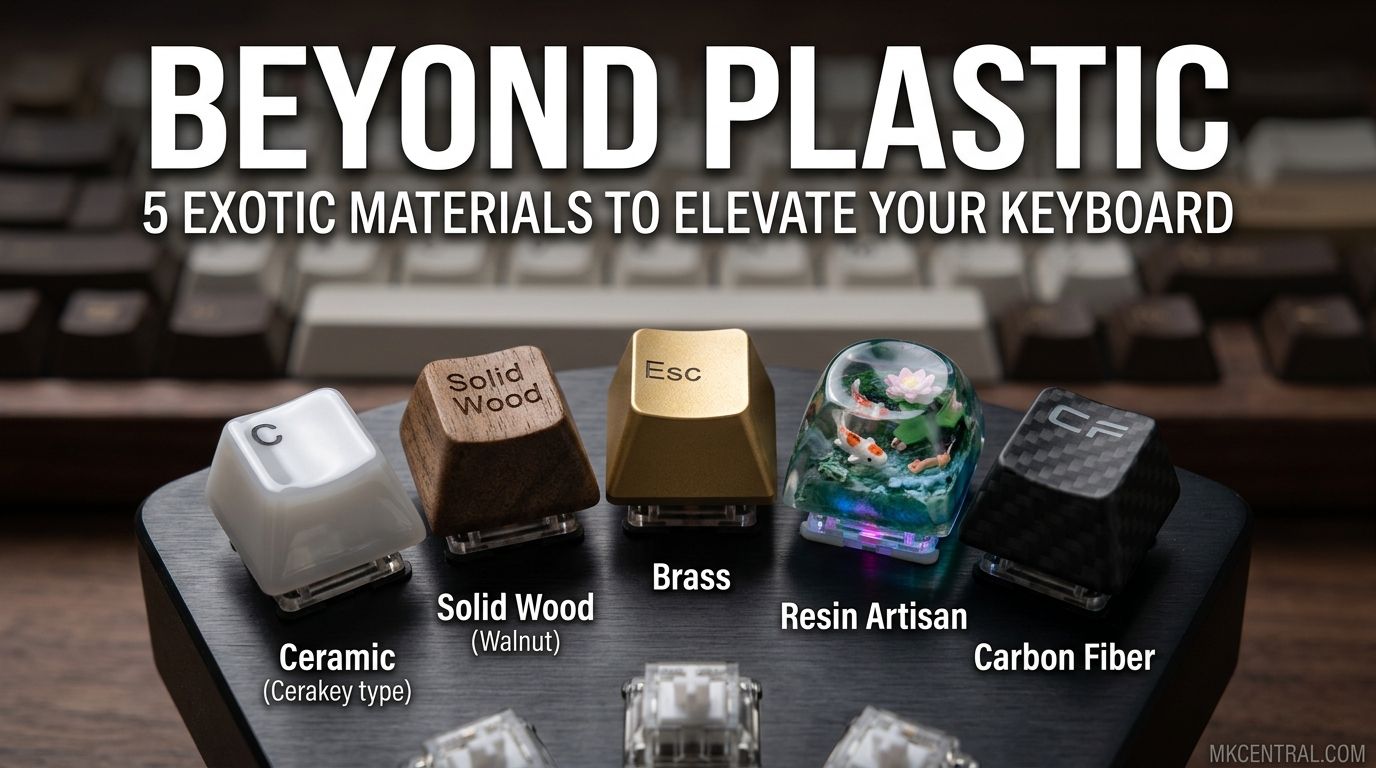
If you’ve spent any time in the mechanical keyboard community (MKC), you know that the "thock" or "clack" isn't just about the switches—it’s about the soul of the materials. While PBT and ABS are the industry standards, there is a growing movement in the US and European markets toward exotic materials that transform a peripheral into a desktop centerpiece.
Whether you are a professional coder or a heavy-hitting gamer, swapping your stock keycaps for something rare isn't just an upgrade—it's a statement. Here are five exotic materials you can actually find today to level up your typing experience.
1. Ceramic: The High-End Feel
Ceramic keycaps, like those pioneered by brands such as Cerakey, have taken the hobby by storm. Unlike plastic, ceramic offers a cold, marble-like touch that warms up to your skin temperature as you type.
- The Sound: They produce a deep, crisp, and uniquely musical sound that plastic simply cannot replicate.
- The Durability: They are incredibly scratch-resistant. Since the legends (letters) are glazed, they will never fade, even after decades of heavy use.
- Pro Tip: Because ceramic is heavier, consider using switches with a slightly higher actuation force (around $55g$ - $65g$) to ensure a snappy return.
2. Solid Wood: Organic Warmth
For those curating a "Zen" or "Dark Academia" desk setup, wooden keycaps (Walnut, Rosewood, or Ebony) are unparalleled.
- Human Element: Each keycap is a tiny piece of nature. No two caps have the same grain pattern. Over time, the wood absorbs the oils from your fingertips, developing a rich "patina" that tells the story of your work.
- The Texture: Expect a soft, matte, and organic feel that reduces sweat-induced slipping.
3. Metal (Brass & Stainless Steel): Industrial Luxury
Metal keycaps are the "heavyweights" of the keyboard world. While a full set of brass keycaps might be overkill (and expensive), using them for your "Artisans" or "Modifiers" is a popular trend in the Western custom scene.
- The Impact: Every keystroke feels deliberate and solid. Brass, in particular, offers a "thump" that feels incredibly premium.
- Finish: You can find them in PVD-coated gold, sandblasted silver, or raw finishes that age beautifully.
4. Resin Artisans: The Miniature Art Gallery
Resin keycaps are where the community’s creativity truly shines. These are often handmade by artists who encapsulate entire worlds inside a single $1u$ key.
- Visual Depth: From miniature koi ponds and snowy mountains to cyberpunk cityscapes, the level of detail is staggering.
- Collectibility: Many of these are sold in "raffle" styles or limited runs, making them highly sought-after assets in the secondary market (like r/mechmarket).
5. Carbon Fiber: The Speedster’s Choice
Borrowed from the world of aerospace and racing, carbon fiber keycaps are for the performance enthusiasts.
- Weight vs. Strength: They are lighter than most plastics but significantly stiffer. This leads to a very sharp, immediate typing feedback.
- Aesthetic: The iconic woven twill pattern gives your board a high-tech, aggressive look that pairs perfectly with RGB lighting.
Final Thoughts for the Enthusiast
Upgrading to exotic materials requires a bit of research into Compatibility. Most of these materials are designed for Cherry MX stems, but always double-check your keyboard’s layout (ISO vs. ANSI) before pulling the trigger on a high-end set.
FAQ: Everything You Need to Know
Q: Are ceramic or metal keycaps too heavy for my keyboard?
A: Most high-quality keyboards can handle the weight, but because these materials are heavier than plastic, your keys might feel "mushier." We recommend swapping to switches with heavier springs to maintain that tactile snap.
Q: Do wooden keycaps crack over time?
A: High-quality wooden caps are CNC-machined and treated with oils or wax to prevent warping. However, it is best to keep them away from extreme humidity or direct sunlight to maintain their structural integrity.
Q: Will these materials damage my switches?
A: As long as the keycaps are designed with a standard "cross" (+) stem, they won't damage your switches. However, metal keycaps with poorly machined stems can sometimes be too tight; always look for reputable vendors with verified reviews.
Q: How do I clean exotic keycaps?
A: * Ceramic/Metal: A microfiber cloth and a tiny bit of isopropyl alcohol.
- Wood: Only use a dry or slightly damp cloth; never soak them in water.
- Resin: Mild soapy water and a soft brush will do the trick.
Q: Where is the best place to buy these in Europe and the US?
A: Keep an eye on specialized vendors like Drop, Kbdfans, or artisan-specific sites like Jelly Key. For the best community advice, Discord and Reddit remain the gold standards for finding the latest group buys.

Laisser un commentaire
Ce site est protégé par hCaptcha, et la Politique de confidentialité et les Conditions de service de hCaptcha s’appliquent.