





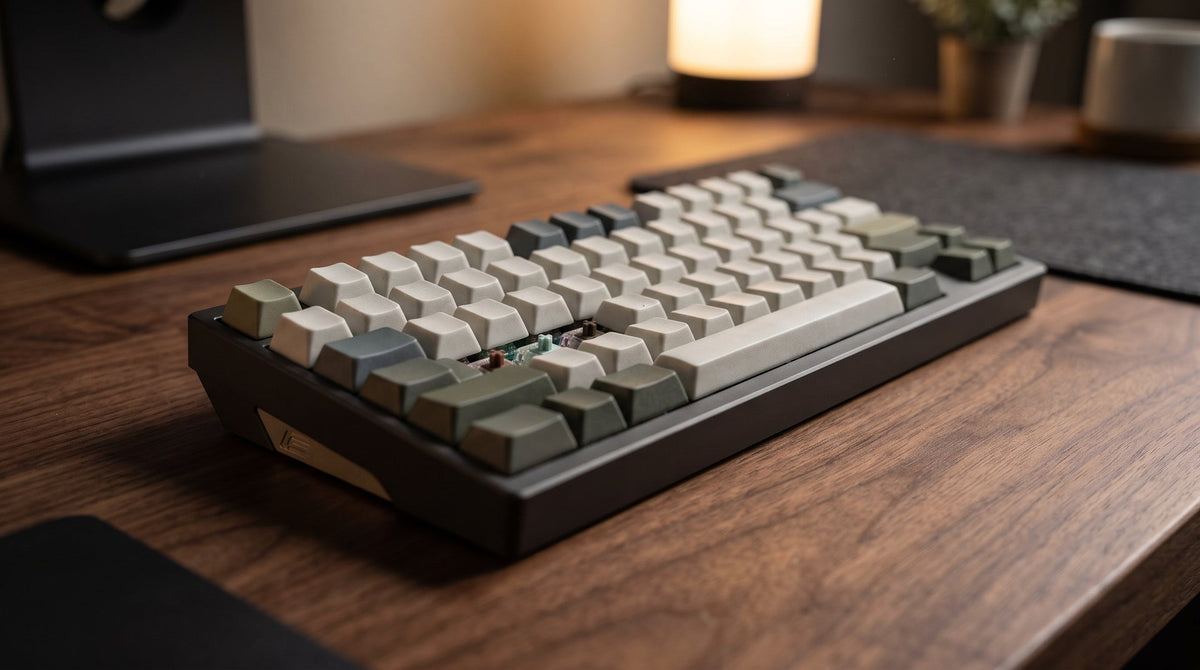
If you hand an office worker a standard off-the-shelf plastic keyboard, they hear noise. If you hand them a custom-tuned mechanical board with lubricated linear switches, a polycarbonate plate, and thick high-density keycaps, they hear music.
Specifically, they hear that intoxicating, low-frequency drop we call "thock."
Over the last few years, the mechanical keyboard hobby underwent a massive acoustic transformation. In the early Cherry MX days, clack reigned supreme. Today, sound test videos on YouTube and TikTok rack up tens of millions of views solely on the merit of deep, pillowy acoustic profiles.
Why has this specific acoustic profile captured everyone from 10-hour-a-day software engineers to casual typing hobbyists? The answer isn't just aesthetic hype—it sits right at the intersection of audio physics, sensory psychology, and tactile ergonomics.
1. What Exactly Is "Thock"? (Acoustic Reality Check)
In keyboard discussions, people throw around onomatopoeic words like clack, thock, thack, and pop with near-religious devotion. To truly understand why people love it, we have to look past the slang and look at frequency spectrums.
- Clack: High-pitched, bright, and snappy. This occurs when rigid materials strike each other without dampening, typically registering between 1,500 Hz and 3,500 Hz. You hear the sharp slap of an ABS keycap bottoming out against an aluminum plate.
- Thock: Deep, rounded, muted, and bass-heavy. A true thock concentrates acoustic energy in the 200 Hz to 600 Hz range. It sounds closer to heavy wooden dominoes dropping onto a solid oak desk.
When you hit a key, you are initiating three distinct sound waves in rapid succession:
- The switch stem hitting the bottom housing (the downstroke).
- The mechanical vibration transferring through the plate into the case cavity.
- The switch stem snapping back up against the top housing (the upstroke).
When those vibrations bounce around inside an uninsulated hollow plastic chassis, you get a tinny, pinging resonance. When that energy is shaped by dense, mass-heavy components and low-rebound damping, the high frequencies dissipate immediately—leaving only the satisfying, resonant low-end punch.
2. Clack vs. Thock: The Physical Breakdown
Building for sound is an exercise in material science. The table below outlines how different components manipulate vibration and sound signature:
| Component | For a Brighter "Clack" (High Pitch) | For a Deep "Thock" (Low Pitch) |
| Switch Housing | Polycarbonate (PC) top, stiffer plastics | Nylon blend, POM, milky housings |
| Switch Stem | Long-pole POM stems (snappy bottom-out) | Standard travel length, dampening materials |
| Mounting Plate | Brass, Aluminum, Carbon Fiber | Polycarbonate, POM, FR4 |
| Mounting Style | Top mount, Integrated plate | Gasket mount, Gummy O-ring |
| Keycap Material | Thin ABS (1.0 mm – 1.2 mm) | Extra-thick PBT (1.5 mm+) or Dense Ceramic Keycaps |
| Acoustic Mods | Open internal cavity, stiff foam | Multi-layer Tempest tape mod, thick desk mats |
3. The Sensory Psychology: ASMR and Cognitive Focus
The obsession with thock isn't purely technical—it is deeply emotional. Most keyboard enthusiasts spend upwards of 40 hours a week in front of screens. Typing is no longer an invisible utility; it is the primary physical interface with digital work.
Micro-Dopamine with Every Keystroke
Every mechanical keystroke delivers dual sensory feedback: tactile resistance under your fingertips and auditory resonance in your ears. When that sound is tuned to a deep, warm frequency, it triggers a response identical to ASMR (Autonomous Sensory Meridian Response). The brain interprets rhythmic, low-frequency clicks as grounding rather than disruptive.
Eliminating Auditory Fatigue
High-pitched, plasticky clatter causes subtle cognitive fatigue over long work sessions. Think of the harsh rattle of a hollow spacebar—it grates on your nerves like a squeaky chair. In contrast, low-frequency sound waves don't pierce through ambient room noise or trigger irritation. Instead, they produce a calm acoustic backdrop that helps you stay locked in the zone.
4. Why Density Wins: The Secret Weapon in Low-End Sound
Most people chase a deep sound by stuffing their keyboard case full of silicone, Poron foam, and layers of painter’s tape. While those mods help absorb hollow echoes, they often turn the board into a muted, lifeless block rather than a truly deep acoustic instrument.
If you want resonance that feels rich instead of suffocated, mass and density are king.
Sound velocity is fundamentally determined by the density of the medium it travels through. Lightweight, thin keycaps vibrate rapidly, amplifying shrill frequencies. Thicker, heavier keycaps absorb that high-frequency chatter before it ever escapes the switch.
This is why experienced builders graduate from thin OEM plastic to 1.5 mm double-shot PBT, and eventually to solid mineral and clay materials. Swapping from standard ABS to high-density glazed ceramic keycaps adds literal weight to the stems. The extra mass acts like a natural low-pass filter: it dampens the switch top-out slap and yields a deep, raindrop-like bottom-out you simply cannot replicate with standard plastic molding.
5. Bench Notes: How to Tune Your Board for Deep Thock
If your keyboard currently sounds more like rattling plastic cutlery than a custom mechanical masterpiece, here is an actionable blueprint tested on our workbench:
- Ditch the Metal Plate for Softer Materials: If your board uses a stiff aluminum or brass plate, replace it with POM or Polycarbonate. Softer plastics absorb harsh impacts and drop the overall pitch by several hundred Hertz.
- Lube Your Switches with Purpose: Over-lubing ruins tactile feedback, but dry switches are a prime source of high-frequency scratchiness. Apply a thin, consistent layer of Krytox 205g0 to the bottom housing rails and stem sliders.
- Try the Tempest Tape Mod: Apply 2 to 3 layers of blue painter's tape directly to the back of your PCB. The tape reflects high-frequency waves while letting low-frequency sound travel through, acting as an acoustic filter.
- Anchor the Foundation: A board resting directly on bare wood or laminate creates an echo chamber. Put a dense, 4 mm felt or rubber desk mat beneath your setup to catch downward acoustic spillover.
The Verdict
People love thocky keyboards because they turn a mundane task into a tactile ritual. In an era where work feels increasingly detached and digital, typing on a tuned, resonant keyboard provides tangible weight and tactile satisfaction.
When your setup sounds as solid as it feels, answering that 50th email of the morning doesn't feel like a chore—it feels like an experience.
Ready to transform your keyboard's acoustic signature?
Explore our collection of Artisan Ceramic Keycaps to add the weight, density, and deep acoustic resonance your build deserves.

Deixar comentário
Este site é protegido por hCaptcha e a Política de privacidade e os Termos de serviço do hCaptcha se aplicam.