




If you play Valorant, Counter-Strike 2, or Apex Legends, you know that competitive gaming has officially entered its "magnetic" era. First, it was Hall Effect (HE) switches and Rapid Trigger technology taking over the pro scene. Now, the hype train has moved on to something even newer: TMR (Tunnel Magnetoresistance) Keyboards.
Hardware reviewers and influencers are claiming TMR is the ultimate killer of input lag. But is it actually going to save you from getting swung around a corner, or is it just marketing snake oil designed to make you open your wallet again?
Let’s separate the quantum-physics hype from real-world FPS performance.
What is a TMR Keyboard anyway?
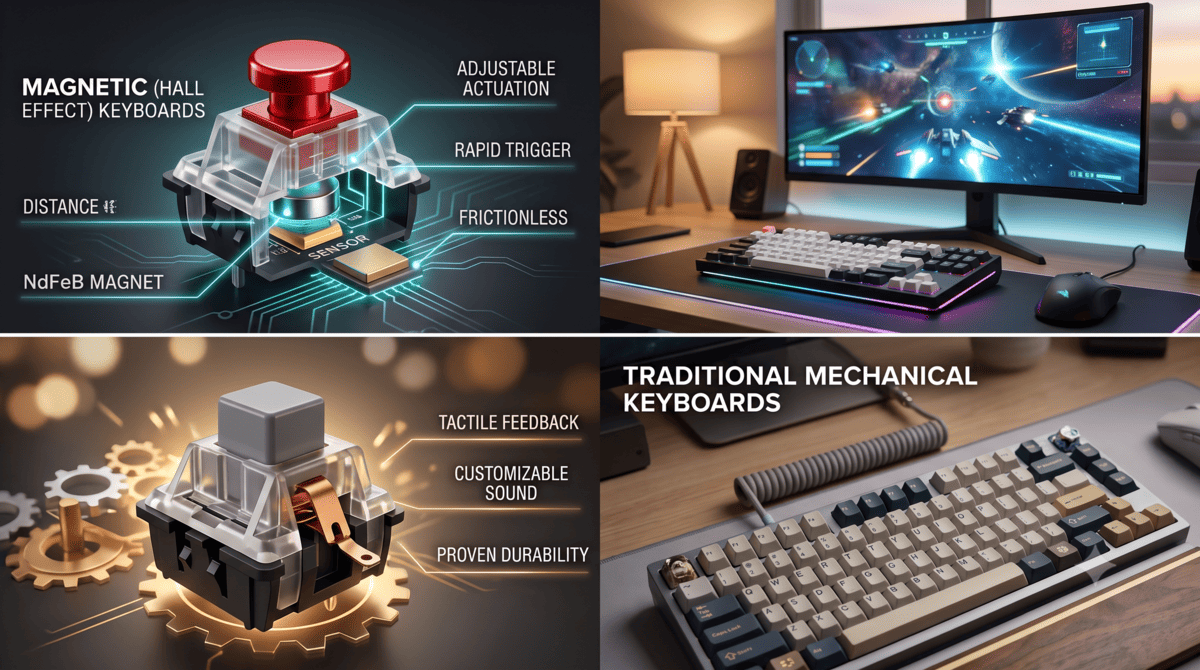
To understand input lag, we have to look at how these switches function. Both Hall Effect and TMR are magnetic, contactless switches. Instead of relying on physical metal leaves rubbing together to complete a circuit, they use a magnet attached to the switch stem and a sensor on the keyboard's PCB to track movement.
However, TMR functions on a quantum-mechanical level:
- Hall Effect (HE): Measures changes in voltage generated across a semiconductor when a magnetic field is present.
- TMR: Measures the changing resistance of electrons "tunneling" through an ultra-thin insulating barrier.
Because TMR tracks changes in resistance rather than raw voltage fluctuations, the signal is incredibly clean, has zero "noise," and requires a fraction of the power.
The Verdict: Does TMR Actually Reduce Input Lag?
The short answer is yes, but not for the reason most people think. If you compare a wired HE keyboard running at a 1,000Hz polling rate to a TMR keyboard running at 1,000Hz, the raw electronic latency difference is practically microscopic (fractions of a millisecond). You will not magically double your rank overnight just from the sensor swap alone.
However, TMR reduces real-world input lag in three massive ways that directly impact FPS gameplay:
1. Stable, True 8,000Hz Polling Rates
Many older Hall Effect keyboards claim to support an 8,000Hz (8K) polling rate, but because HE sensors pull a lot of power and generate a noisy signal, running them at 8K often causes signal jitter or CPU throttling. TMR’s ultra-clean signal allows keyboards to run at a true, stable 8K polling rate. This drops your input reporting interval from 1ms down to just 0.125ms.
2. Elimination of Debounce Delay
Traditional mechanical switches require a "debounce delay" (usually 2ms to 5ms) to prevent the keyboard from registering double-clicks caused by physical metal leaves bouncing. Because TMR is contactless, debounce lag is 0ms. The moment the magnet moves, the action registers.
3. Insane Rapid Trigger Precision
In FPS games, breaking your movement momentum to get an accurate shot accuracy (counter-strafing) is everything. TMR allows for hyper-accurate Rapid Trigger configurations. The switch resets the exact micrometer you start lifting your finger, rather than waiting for the switch to travel back up past a fixed reset point.
The Problem: The TMR Market is Still Coiled Up
While TMR technology is undeniably the future of esports peripherals, it has a glaring problem right now: availability and price. Because TMR is cutting-edge tech, true TMR keyboards are currently incredibly rare, highly expensive, and often locked behind long pre-order queues. Furthermore, many early-batch TMR boards suffer from unpolished software, making it frustrating to map keys or dial in your dead zones.
What Should You Do Right Now?
If you want an unfair hardware advantage in your ranked matches tonight, you do not need to wait for TMR to become mainstream. The current generation of mature, optimized Hall Effect (HE) magnetic keyboards offers 95% of the performance benefits of TMR—including adjustable actuation and Rapid Trigger—but at a fraction of the cost and with incredibly stable, battle-tested software.
While we are currently working behind the scenes with our suppliers to source reliable, top-tier TMR platforms for our store shelves in the future, you can instantly upgrade your response times today.
Check out our curated lineup of [High-Performance Magnetic Gaming Keyboards] that are in stock, shipping right now, and fully equipped with tournament-ready Rapid Trigger technology to help you lock down those crisp crosshair placements.
TMR Keyboards FAQ
Q1: What is the main difference between TMR and Hall Effect (HE) keyboards?
A: While both are magnetic, contactless switches that offer Rapid Trigger, they measure magnetism differently. Hall Effect sensors measure voltage changes, while TMR (Tunnel Magnetoresistance) sensors measure changes in electrical resistance via quantum tunneling. For gamers, this means TMR delivers a cleaner signal, zero thermal drift, drastically lower power consumption (crucial for wireless boards), and more stable performance at 8,000Hz polling rates.
Q2: Do TMR keyboards require special switches?
A: Yes. TMR switches do not have the metal pins found on traditional mechanical switches; instead, they rely on an internal magnet. Furthermore, you cannot always swap Hall Effect switches into a TMR board (or vice versa), as the sensors are highly sensitive to the specific magnetic polarity (North vs. South pole) and physical structural housing of the switch.
Q3: Will a TMR keyboard instantly make me better at FPS games?
A: It won’t replace good aim or game sense, but it does remove physical hardware bottlenecks. TMR completely eliminates debounce delay and allows for the most precise Rapid Trigger response currently engineered. If your playstyle heavily relies on micro-strafing, jiggle-peeking, or instant counter-strafing in games like Valorant or CS2, the difference in responsiveness is absolutely noticeable.
Q4: Are TMR keyboards worth it right now?
A: TMR is undoubtedly the future of gaming peripherals, but because the technology is so new, options are currently limited and premium-priced. If you want a competitive edge today without waiting for pre-orders, a high-quality, mature Hall Effect (HE) keyboard gives you almost identical real-world in-game responsiveness, excellent software stability, and a much friendlier price tag.
💡 Ready to upgrade your setup? Don't wait on backorders. Browse our [In-Stock Magnetic/HE Gaming Keyboards] and start dominating your lobby tonight with instant Rapid Trigger performance!

Leave a comment
This site is protected by hCaptcha and the hCaptcha Privacy Policy and Terms of Service apply.