



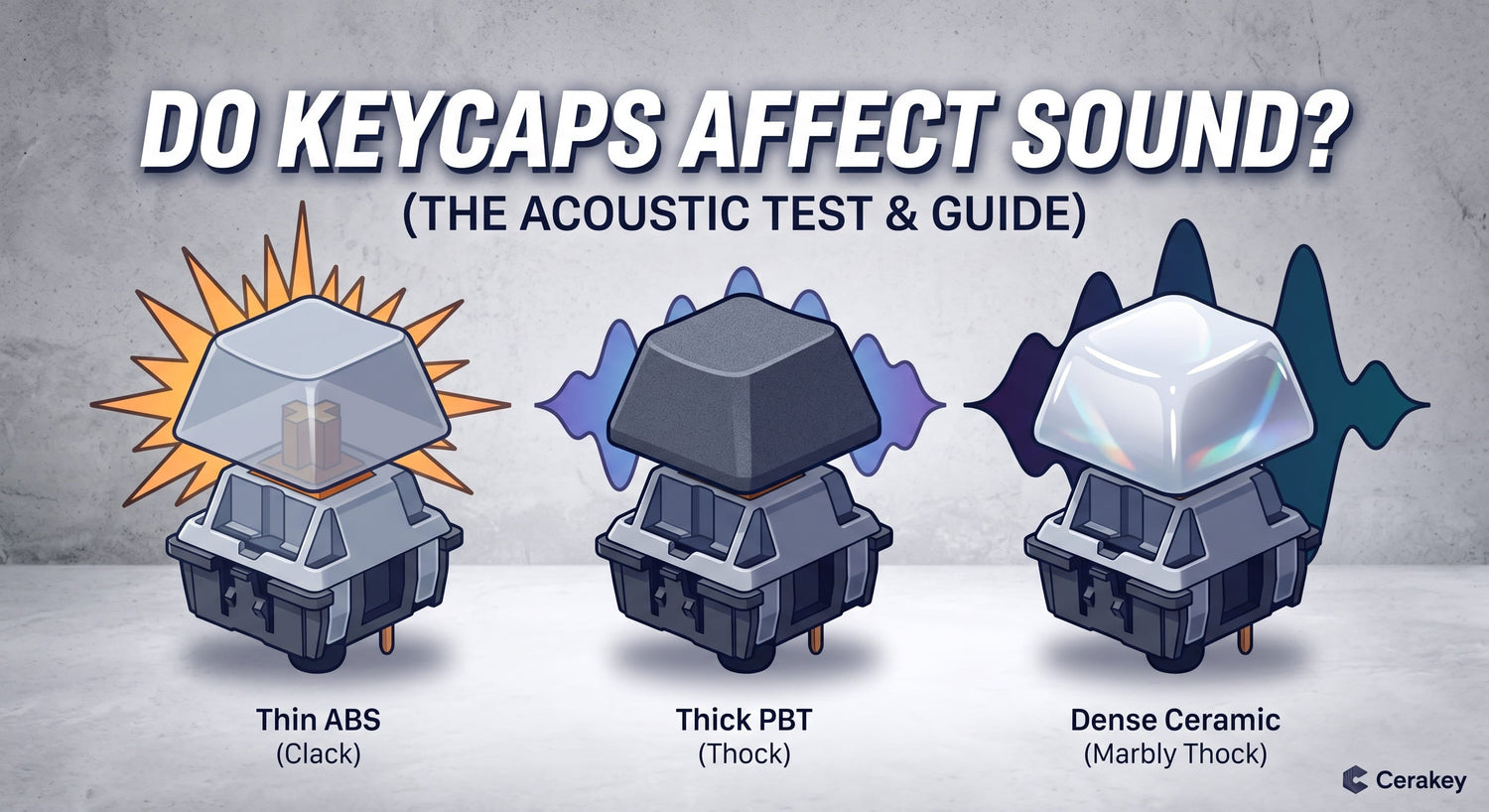
Swap a thin OEM ABS keycap for a thick ceramic or PBT cap, and your keyboard will sound like an entirely different board.
While switches define the initial mechanical strike, your keycaps act as acoustic chambers. Every keystroke sends vibrations upward through the switch stem into the keycap shell. The cap's mass, wall thickness, internal volume, and material density dictate which audio frequencies are amplified and which are absorbed.
The Physics: Why Keycaps Shape Sound
A keycap is essentially a tiny acoustic amplifier. The final sound profile—whether you get a crisp, high-pitched clack or a deep, muted thock—comes down to three physical factors:
- Material Density & Mass: Denser materials absorb high-frequency vibrations rather than echoing them. Lighter plastics resonate at higher pitches, while heavier materials shift the sound wave downward into lower, deeper registers.
- Wall Thickness: Keycaps with thin walls (<1.1mm) flex slightly upon impact, generating a hollow, plasticky rattle. Walls measuring 1.4mm to 1.6mm—or dense solid structures—dampen internal reverberation and produce a cleaner bottom-out sound.
- Internal Cavity Volume (Profile Height): Taller keycap profiles have larger internal air chambers. More air space creates an echo chamber that deepens resonance, whereas low-profile caps leave zero room for sound to bounce.
Material Breakdown: ABS vs. PBT vs. Ceramic
The material hitting your fingers makes the single biggest difference in acoustic tone.
1. ABS (Acrylonitrile Butadiene Styrene)
Standard stock ABS keycaps are lightweight and flexible. When struck, they reflect vibrations quickly, producing a sharp, bright "clack." While premium, extra-thick ABS sets (like vintage doubleshots) can sound pleasantly crisp, thin OEM ABS sets often sound hollow and tinny.
2. PBT (Polybutylene Terephthalate)
PBT is a denser, stiffer thermoplastic with a textured surface. Because it resists vibration better than ABS, it produces a lower-pitched, subdued "thock." Thick-walled (1.5mm) PBT remains a standard choice for enthusiasts chasing a muted, deeper bottom-out sound.
3. Ceramic (Industrial-Grade Alumina)
Ceramic introduces physical properties plastics cannot replicate. Alumina ceramic is significantly denser and heavier than both ABS and PBT.
When a switch bottoms out against a Cerakey Ceramic Keycap, the extreme material density eliminates the hollow plastic reverberation entirely. The result is a distinct, deep, marbly acoustic profile with a pure low-frequency thock that plastic blends cannot reproduce.
How Keycap Profiles Change the Pitch
A keycap's height and shape determine how much air is trapped underneath the shell.
- Cherry & OEM Profiles: Low-to-medium height with modest internal chambers. They maintain a balanced sound profile that highlights switch characteristics without over-amplifying low-end bass.
- SA, MT3, & KAT Profiles: High-profile, sculpted spherical caps with huge internal cavities. They act like miniature soundboards, lowering the pitch of even high-pitched switches into a booming, deep register.
- XDA & DSA Profiles: Uniform height with flat tops and minimal air volume. They produce a consistent, uniform acoustic response across all rows with shorter resonance decay.
Acoustic Comparison: Materials & Sound Profiles
| Material | Wall Thickness | Acoustic Signature | Pitch | Hollow Resonance |
| Thin ABS | 0.8mm – 1.0mm | Sharp, plasticky clack | High | High |
| Thick ABS | 1.4mm – 1.6mm | Crisp, solid clack | Mid-High | Low |
| Standard PBT | 1.2mm – 1.4mm | Muted, clean snap | Mid | Low |
| Thick PBT | 1.5mm – 1.7mm | Rounded, deep thock | Low-Mid | Very Low |
| Ceramic | Solid Glazed/Matte | Deep, marble-like thock | Ultra-Low | None |
Hands-On Bench Test: How Keycaps React Across Switches
To isolate keycap acoustics, we mounted three different sets on the same aluminum gasket-mount board (polycarbonate plate, case foam installed, tape-modded PCB):
- With Linear Switches (e.g., Gateron Oil Kings): Thick PBT smoothed out the stroke, but Ceramic completely eliminated high-frequency stem noise, leaving only a deep, solid acoustic strike.
- With Tactile Switches (e.g., Boba U4T / Holy Pandas): ABS amplified the tactile leaf snap into a sharp click. Ceramic absorbed the harsh top-end snap and emphasized the bottom-out impact.
- With Clicky Switches (e.g., Kailh Box Jades): High-profile ABS accentuated the metallic click bar, while ceramic grounded the bottom-out sound beneath the click.
How to Choose the Right Keycaps for Your Sound Goal
- If you want a bright, snappy, retro "Clack": Choose high-grade, thick-wall ABS keycaps in standard Cherry or OEM profile.
- If you want a warm, muted, daily-driver "Thock": Opt for thick double-shot PBT keycaps (1.5mm+) paired with linear switches.
- If you want maximum depth and a heavy, marbly sound: Upgrade to Ceramic Keycaps. The density eliminates plastic ping and brings out the deepest acoustic register your custom board can produce.
Ready to completely transform your keyboard's acoustic profile? Explore the Cerakey Ceramic Keycap Collection to hear and feel the difference high-density ceramics bring to every keystroke.

แสดงความคิดเห็น
เว็บไซต์นี้ได้รับการคุ้มครองโดย hCaptcha และมีการนำนโยบายความเป็นส่วนตัวของ hCaptcha และข้อกำหนดในการใช้บริการมาใช้